

Most serious bettors underestimate how frequently market odds fail to reflect true probabilities, leaving substantial value uncaptured. Even experienced punters often chase high odds without calculating whether those odds represent genuine mathematical edges over bookmakers. This guide explains precisely how to identify, quantify, and exploit value betting opportunities using data-driven methods that have demonstrably generated triple-digit returns for disciplined practitioners.
Table of Contents
- The Fundamentals Of Value Betting And Probability Assessment
- Market Efficiency And Benchmarks: Beating The Bookmakers
- Advanced Strategies: Combining Predictive Models And Bankroll Management
- Leveraging Automation And Machine Learning To Capture Value
- Discover How Proppr Can Automate Your Value Betting Strategies
Key takeaways
| Point | Details |
|---|---|
| Value betting identifies discrepancies | Market odds frequently diverge from true probabilities, creating mathematically exploitable opportunities for informed bettors. |
| Data-driven models reveal hidden edges | Probabilistic prediction models uncover subtle market inefficiencies that bookmakers miss consistently. |
| Bankroll management multiplies profits | The Kelly Criterion optimises bet sizing and outperforms fixed-fractional strategies by 30% annually. |
| Market overrounds vary significantly | Top-tier leagues exhibit 4.1% to 5.1% overrounds whilst lower leagues often exceed 8%, directly impacting value potential. |
| Automation accelerates value capture | Machine learning workflows have achieved 107% ROI by processing data faster than manual analysis allows. |
The fundamentals of value betting and probability assessment
Value betting requires identifying discrepancies between implied probabilities from odds and your calculated assessment of actual event probabilities. When bookmakers price a match incorrectly, you can exploit that mispricing systematically for profit.
Implied probability converts decimal odds into percentage terms using the formula: Implied Probability = 1 / Decimal Odds. A team priced at 2.50 carries an implied probability of 40%. If your analysis suggests the true probability sits closer to 45%, you've identified a value opportunity worth pursuing.
The mathematical definition of value uses this formula: Value = (Market Odds / Fair Odds) - 1. Positive results indicate profitable situations. If you calculate fair odds of 2.00 for an outcome but find market odds of 2.40, your value calculation yields 0.20 or 20% edge. Understanding value betting mechanics at this foundational level separates profitable bettors from recreational punters.
Common pitfalls plague probability estimation efforts:
- Overweighting recent form whilst ignoring regression to mean principles
- Failing to account for contextual factors like squad rotation or injury impacts
- Miscalculating home advantage effects across different league structures
- Ignoring the compounding impact of bookmaker margins on long-term profitability
Consider this practical example. Manchester City faces Brighton with market odds of 1.30 for a City victory, implying 76.9% probability. Your statistical model, accounting for squad availability, recent defensive metrics, and historical matchup data, calculates a true probability of 82%. Your fair odds would be 1.22. Using the value formula: (1.30 / 1.22) - 1 = 0.066 or 6.6% value. This represents a genuine mathematical edge worth backing with appropriate stake sizing.
Market efficiency and benchmarks: beating the bookmakers
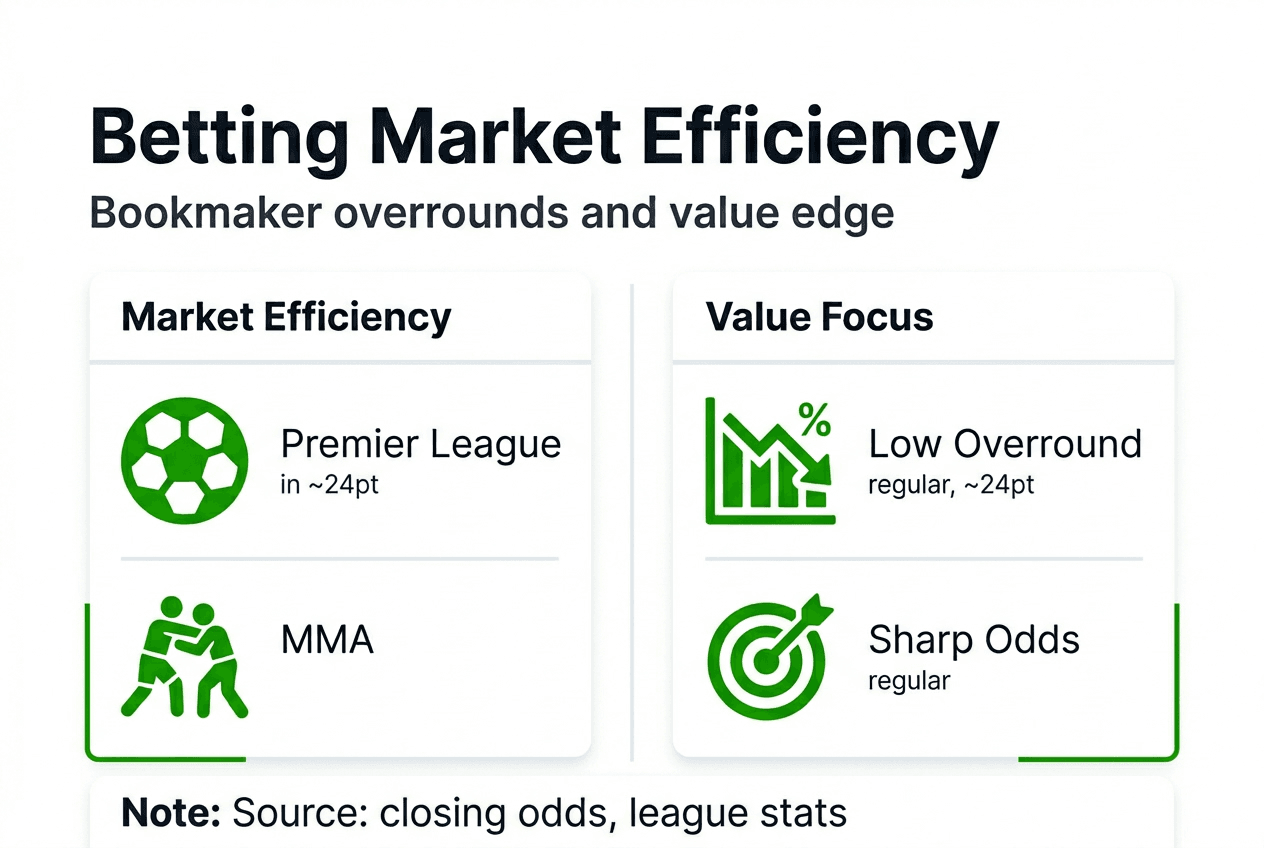
Overround measures how much bookmakers build profit margin into their odds across all possible outcomes. Lower overrounds indicate more efficient markets where finding value becomes harder but not impossible. Top-tier leagues exhibit overrounds between 4.1% and 5.1%, reflecting intense competition and information efficiency.
| League | Average Overround | Value Potential |
|---|---|---|
| Premier League | 4.1% | Lower but consistent |
| La Liga | 4.6% | Moderate with selective spots |
| Serie A | 4.8% | Similar to La Liga |
| Bundesliga | 5.1% | Slightly higher margins |
| Championship | 7.2% | Higher potential edges |
| League One | 8.9% | Substantial but less liquid |
Pinnacle's closing odds consistently represent the sharpest available market prices because sharp bettors with superior information models move those lines aggressively. Beating these Pinnacle closing odds benchmarks over meaningful sample sizes demonstrates genuine forecasting skill rather than temporary luck.
Pro Tip: Focus your betting activity on leagues with overrounds below 6% once you've validated your edge, then selectively attack higher-overround markets only when your conviction reaches extreme levels backed by unique informational advantages.
Market efficiency varies dramatically across sports. MMA betting markets show remarkably high efficiency with minimal exploitable bias patterns, making consistent profitability challenging without specialised knowledge. Football markets, conversely, exhibit more frequent inefficiencies due to the complex interplay of squad rotation, tactical matchups, and psychological factors that bookmakers sometimes misprice. Understanding these efficiency gradients through league overround analysis helps you allocate research time where edges actually exist rather than grinding against brick walls.
Advanced strategies: combining predictive models and bankroll management
Probabilistic prediction models transform raw match data into probability estimates that power systematic value betting approaches. These models ingest historical results, expected goals metrics, squad valuations, and contextual variables to output match outcome probabilities more accurate than bookmaker assessments. Combining these probabilistic predictions with disciplined betting strategies yields statistically significant profits in football markets, though sustaining long-term edges requires constant model refinement.
Challenges in maintaining profitability include:
- Market adaptation as bookmakers integrate similar data sources
- Variance obscuring genuine edges over short timeframes
- Overconfidence leading to stake sizing errors during winning streaks
- Model decay as team dynamics and tactical trends evolve
Bankroll management separates theoretical edges from realised profits. The Kelly Criterion calculates optimal bet sizing using your edge and the odds offered: Kelly % = (Edge × Decimal Odds - 1) / (Decimal Odds - 1). With a 5% edge on 2.50 odds, Kelly suggests wagering 3.33% of your bankroll. This criterion maximises growth and outperforms fixed-fractional approaches by 30% annually by dynamically adjusting stakes to match confidence levels.

Pro Tip: Apply fractional Kelly, betting 25% to 50% of the calculated Kelly stake, to reduce volatility whilst preserving substantial long-term growth advantages without risking catastrophic drawdowns during inevitable losing runs.
Successful bankroll management tactics require tracking every wager, calculating closing line value on all positions, and maintaining strict separation between betting capital and personal finances. Record-keeping reveals patterns in your edge distribution across markets, times, and bet types, enabling continuous strategy refinement based on empirical performance rather than gut feelings.
Leveraging automation and machine learning to capture value
Machine learning models detect subtle inefficiencies invisible to traditional analysis by processing vast datasets at speeds impossible manually. These models identify patterns where bookmakers systematically misprice specific situations like derby matches, fixture congestion periods, or managerial changes. One publicly documented ML approach achieved 107% ROI by finding consistent edges over bookmaker closing odds through rigorous data analysis.
A typical ML-powered value betting workflow operates as follows:
- Aggregate odds data from 150+ bookmakers alongside historical results databases
- Train gradient boosting or neural network models on features including form, fixtures, and squad metrics
- Generate match outcome probability distributions with confidence intervals
- Compare model probabilities against current market odds to identify value discrepancies
- Execute bets automatically when value threshold criteria are satisfied
- Track closing line value and actual results to validate model accuracy continuously
Automation delivers three critical advantages over manual processes. Speed ensures you capture optimal odds before markets adjust to new information. Accuracy eliminates emotional decision-making and calculation errors that plague discretionary betting. Reduced effort lets you scale across multiple leagues and markets simultaneously without proportional time investment increases.
Machine learning transforms value betting from labour-intensive probability estimation into systematic edge exploitation, enabling serious bettors to compete directly with bookmaker pricing models using equivalent computational firepower previously exclusive to professional syndicates.
Implementing these automated betting tools requires initial setup effort but pays compounding dividends as your models learn and refine. The key lies in treating betting as a data problem requiring engineering solutions rather than an intuition game. Sophisticated data-driven betting platforms now place institutional-grade capabilities within reach of individual bettors willing to embrace quantitative approaches over traditional handicapping methods.
Discover how Proppr can automate your value betting strategies
Proppr consolidates odds from over 150 bookmakers, live statistics, and proprietary Cebro model outputs into a streamlined Telegram interface that replaces chaotic multi-tab workflows with single-command execution. Serious bettors gain instant access to value bet alerts, arbitrage opportunities, and comprehensive match analysis without manual data gathering.

The platform's arb bot, team bot, and player bot deliver tailored strategies matching your specific betting preferences and bankroll requirements. Rather than spending hours comparing odds and calculating probabilities manually, you receive mathematically verified recommendations based on position-aware analysis that eliminates AI hallucination risks inherent in competitor tools.
Start with the Proppr quickstart guide to rapidly configure your preferred leagues, odds thresholds, and notification settings. The automation handles tedious data processing whilst you focus on strategic decisions about stake sizing and portfolio construction. For bettors applying the advanced concepts covered throughout this guide, Proppr provides the technological infrastructure to scale your edge efficiently across markets that would overwhelm manual analysis capacity.
FAQ
What is value betting and how do I calculate it?
Value betting finds situations where your probability assessment exceeds the implied probability from bookmaker odds. Calculate value using this formula: Value = (Market Odds / Fair Odds) - 1, where positive results indicate profitable opportunities worth backing.
How does the Kelly Criterion improve bankroll management in value betting?
The Kelly Criterion calculates optimal bet sizing by balancing your edge against odds offered, maximising long-term bankroll growth. It outperforms fixed-fractional betting by 30% annually whilst preventing both under-betting profitable situations and over-betting marginal edges that risk ruin.
Why should I use Pinnacle's closing odds as a benchmark?
Pinnacle's closing odds reflect sharp market consensus incorporating all available information from professional bettors. Consistently beating these odds over large sample sizes demonstrates genuine forecasting skill rather than luck, providing objective validation of your value identification process.
Are all sports betting markets equally efficient?
MMA markets exhibit high efficiency with minimal exploitable patterns, making consistent profits difficult without specialised knowledge. Football markets show more frequent inefficiencies due to complex tactical interactions and squad rotation factors that bookmakers sometimes misprice, creating superior value betting opportunities for disciplined analysts.
Can machine learning really generate 100%+ ROI in sports betting?
Documented case studies show ML models achieving 107% ROI by systematically identifying bookmaker pricing errors. Success requires rigorous data quality, proper model validation, disciplined bankroll management, and continuous refinement as markets adapt to similar approaches over time.