

Most sports bettors lose money year after year, trapped in a cycle of gut feelings and surface level analysis. The difference between consistent losers and long term winners comes down to one critical factor: mastering team statistics. This guide reveals how data driven approaches transform betting from hopeful gambling into strategic investing, showing you the exact metrics and methods serious bettors use to uncover value that bookmakers miss.
Table of Contents
- Understanding The Problem: Why Most Bettors Lose And The Need For Team Stats
- Preparing Your Data Toolkit: Tracking Every Wager And Key Team Metrics
- Key Team Statistics Explained: Expected Goals, Defensive Metrics, And Rating Models
- Applying Analytics To Betting: Avoiding Fallacies And Gaining An Edge
- Enhance Your Betting With Proppr's Team Statistics Tools
Key takeaways
| Point | Details |
|---|---|
| Strategic data use transforms betting success | Over 90% of bettors lose long term without structured statistical analysis. |
| Track comprehensive wager data systematically | Document every bet with team metrics, odds, results, and profit/loss to identify profitable patterns. |
| Advanced metrics reveal hidden value | Expected goals (xG), defensive ratings, and Bayesian models predict outcomes more accurately than traditional stats. |
| Avoid cognitive biases and fallacies | Statistical discipline beats intuition by focusing on valid correlations rather than false patterns. |
| Automation accelerates competitive advantage | Specialised tools streamline data collection and analysis, helping you spot opportunities before markets adjust. |
Understanding the problem: why most bettors lose and the need for team stats
The harsh reality facing sports bettors is brutal. Over 90% lose money long term, haemorrhaging funds through poor decision making and inadequate analysis. Many bettors rely on intuition, recent form, or headline statistics without understanding the underlying performance drivers that truly predict outcomes.
This widespread failure stems from three fundamental mistakes:
- Treating betting as entertainment rather than investment, with no systematic tracking or review process
- Using shallow statistics like final scores without examining shot quality, possession efficiency, or defensive vulnerabilities
- Following crowd sentiment and media narratives instead of objective data that reveals market inefficiencies
The bookmakers maintain their edge precisely because most bettors operate this way. They price markets efficiently only when bettors collectively analyse information properly. Your opportunity lies in the gaps where superficial analysis dominates and deeper statistical insight reveals genuine value.
"Self analysis transforms intuition into smart investing by revealing which strategies actually work and which merely feel right."
Structured approaches uniquely benefit betting prospects because they force discipline and objectivity. When you systematically track team statistics, you spot patterns invisible to casual observers. You recognise when a team's underlying performance metrics suggest better results ahead, even when recent results look poor. Tools like Proppr's arb bot automate this process, identifying mathematical opportunities across multiple bookmakers simultaneously.
The path forward requires commitment to data collection and statistical literacy. Without these foundations, you remain trapped in the losing majority, betting blind whilst others operate with genuine insight.
Preparing your data toolkit: tracking every wager and key team metrics
Building a comprehensive tracking system forms the bedrock of serious betting analysis. Creating detailed records of every wager including sport type, league, matchup, date, bet amount, odds, outcome, and net profit or loss enables you to audit your betting habits and identify what actually works.
Start by establishing these essential tracking categories:
- Basic wager information: sport, league, teams involved, match date, bet placed date
- Financial details: stake amount, odds format, odds value, potential return
- Bet specifications: market type (match result, over/under, handicap), specific selection
- Team statistics pre-match: recent form, head-to-head records, home/away splits
- Advanced metrics: expected goals (xG), expected goals against (xGA), possession quality
- Outcome data: actual result, profit or loss, percentage return on stake
- Post-match analysis: why the bet won or lost, whether the reasoning was sound
Organise your spreadsheet to enable filtering and analysis by multiple dimensions. You need to identify win rates by sport, league, bet type, and stake level. This granular view reveals where your edge exists and where you merely think it does.
Pro Tip: Add a "confidence level" column rating each bet from 1-5 stars. After 100+ wagers, compare actual win rates across confidence levels. If your 5-star bets don't significantly outperform 2-star bets, your selection process needs refinement.
| Tracking Field | Purpose | Example Value |
|---|---|---|
| Match ID | Unique identifier | PL_2026_001 |
| Teams | Participants | Arsenal vs Chelsea |
| Pre-match xG | Expected goals forecast | 1.8 vs 1.2 |
| Bet Type | Market selection | Over 2.5 goals |
| Odds | Bookmaker price | 1.95 |
| Stake | Amount risked | £50 |
| Result | Outcome | Win (+£47.50) |
Prepare your data for deeper analysis by maintaining consistency in formatting. Use dropdown lists for categorical variables like league names and bet types. Standardise team name spellings. These seemingly minor details prevent headaches when running statistical analysis or building predictive models later.
Platforms like Proppr's team bot insights automate much of this data collection, pulling real-time statistics and tracking performance without manual spreadsheet maintenance. The time saved compounds into more thorough pre-match analysis.
Key team statistics explained: expected goals, defensive metrics, and rating models
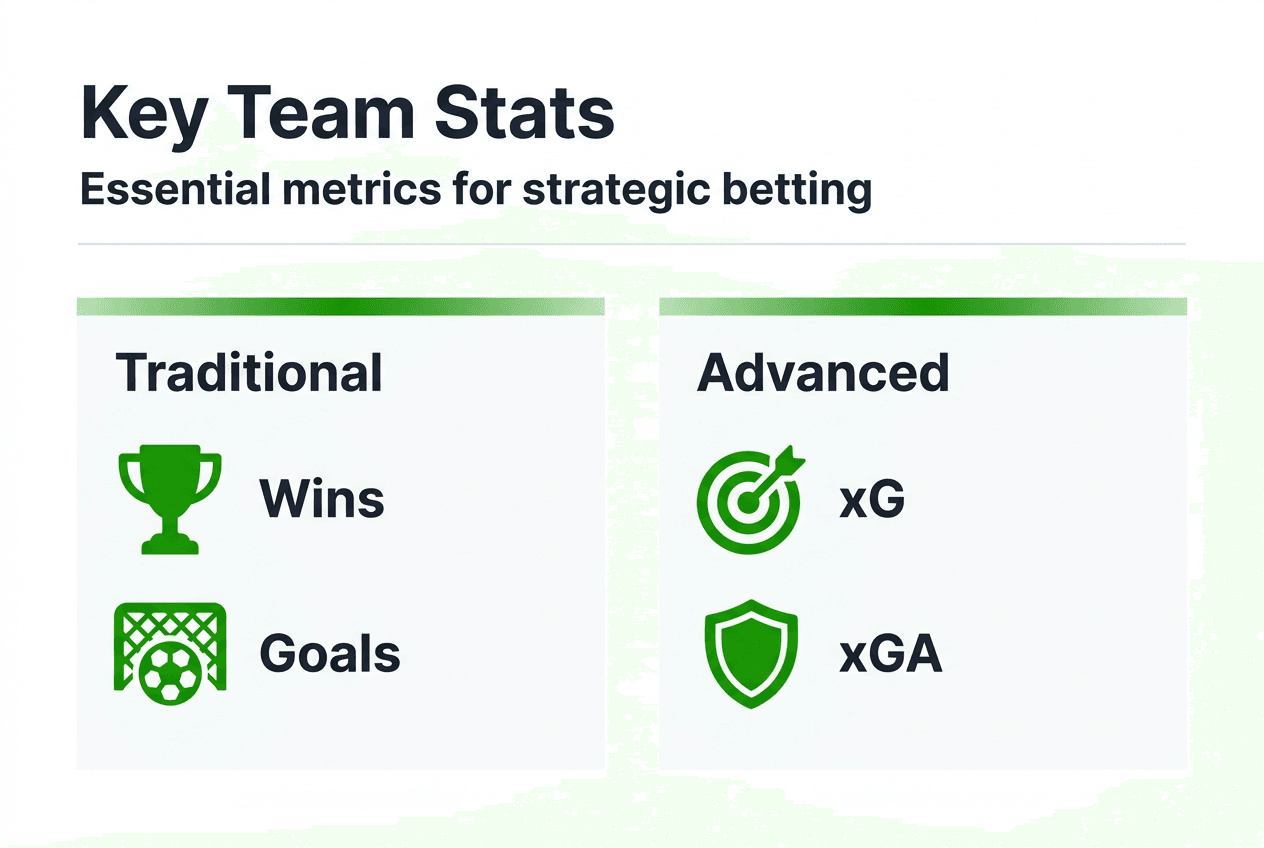
Moving beyond basic win/loss records requires understanding advanced metrics that quantify team quality with precision. Expected goals (xG) measures shot quality by assigning probability to each attempt based on location, assist type, defensive pressure, and other factors. A team generating 2.3 xG per match but scoring only 1.1 goals is likely underperforming and due for positive regression.

Expected goals against (xGA) reveals defensive quality beyond goals conceded. A team allowing 0.8 goals per match might seem defensively solid, but if their xGA sits at 1.9, they've benefited from unsustainable goalkeeper heroics or opponent finishing luck. That defensive vulnerability will eventually surface, creating betting value for astute observers.
Teams deviating strongly from their xG typically face regression towards their underlying performance level. A side scoring 15 goals from 8.2 xG over five matches has been clinical, but expecting that 183% conversion rate to continue defies statistical probability. Bookmakers often price based on recent results rather than underlying metrics, creating opportunities.
Pro Tip: Track the xG difference (xG minus xGA) as a simple power rating. Teams with consistently positive xG difference outperform their league position, whilst those with negative xG difference flatter to deceive despite good results.
The Bayesian Estimate of Strength & Talent (BEST) model represents a sophisticated ratings system estimating team strengths and predicting goals scored in matchups. This model combines xG, post-shot xG (PSxG), expected threat (xThreat), and adjusts for context like red cards, penalties, and time decay. The Bayesian approach updates beliefs about team quality based on accumulating evidence rather than treating all matches equally.
| Metric Type | Traditional Stat | Advanced Alternative | Why It Matters |
|---|---|---|---|
| Attacking | Goals scored | Expected goals (xG) | Reveals shot quality and finishing luck |
| Defending | Goals conceded | Expected goals against (xGA) | Exposes defensive vulnerabilities hidden by goalkeeper performance |
| Overall strength | League position | BEST model rating | Accounts for schedule strength and recent form with statistical rigour |
| Possession | Pass completion % | Expected threat (xThreat) | Measures dangerous possession rather than safe passing |
Proppr's team bot aggregates these advanced metrics automatically, presenting them in actionable formats that highlight statistical edges. You focus on interpretation whilst the platform handles data collection and calculation.
Understanding these metrics transforms how you evaluate matches. Instead of seeing "Manchester City vs Nottingham Forest" as obvious favourites facing probable relegation candidates, you examine whether City's xG dominance justifies the odds or whether Forest's defensive metrics suggest they could frustrate the favourites more often than markets expect.
Applying analytics to betting: avoiding fallacies and gaining an edge
Translating statistical knowledge into profitable betting requires discipline to avoid cognitive traps that undermine otherwise sound analysis. The gambler's fallacy represents the mistaken belief that past independent events affect future probabilities. A team that has lost five consecutive matches is not "due" to win simply because of that streak.
Each match stands as an independent event with probabilities determined by current team quality, fitness, tactics, and context. Past results matter only insofar as they provide evidence about underlying team strength. Focus on whether those five losses revealed genuine weaknesses or reflected variance and opponent quality.
Common analytical traps to avoid:
- Recency bias: overweighting recent performances whilst ignoring larger sample sizes that better represent true quality
- Narrative fallacies: believing in momentum, clutch performance, or destiny rather than statistical probability
- Cherry picking: selecting specific statistics that support your preferred conclusion whilst ignoring contradictory evidence
- Outcome bias: judging decision quality by results rather than process, leading you to repeat profitable mistakes and abandon sound strategies after unlucky losses
"Statistical discipline beats intuition by identifying valid correlations that genuinely predict outcomes, separating signal from noise in the chaos of sports results."
Inferential analysis proves crucial for accurate football prediction, requiring precise measures of team quality whilst accommodating nuances in the data. This approach recognises that observed results contain both signal (actual team quality differences) and noise (random variation). Your goal is extracting signal to inform betting decisions.
Staying ahead means interpreting statistics before bookmakers adjust their prices. When you spot a team consistently outperforming or underperforming their xG metrics, you can position yourself before the market corrects. Bookmakers eventually adjust, but early movers capture the best odds and maximum value.
The Proppr quickstart guide demonstrates how to set up automated alerts for statistical edges, ensuring you never miss opportunities when your criteria are met. This systematic approach removes emotion and timing guesswork from the equation.
Develop clear rules for what constitutes a valid betting opportunity. Perhaps you only bet when a team's xG difference exceeds their opponent's by 0.8+ goals, and the odds imply probability below your calculated probability by 5+ percentage points. Whatever your criteria, apply them consistently and track results to validate or refine your approach.
Enhance your betting with Proppr's team statistics tools
Applying these statistical principles manually demands significant time and expertise. Proppr's team bot automates the heavy lifting, delivering comprehensive team statistics, advanced metrics, and match analysis directly through Telegram. You receive instant access to xG data, defensive ratings, recent form analysis, and BEST model predictions without maintaining complex spreadsheets.

The arb bot complements statistical analysis by identifying arbitrage opportunities across 150+ bookmakers, guaranteeing profit regardless of match outcomes. Whilst team statistics help you find value bets, arbitrage provides risk-free returns when pricing discrepancies emerge.
Serious bettors gain competitive advantage through speed and accuracy. Visit Proppr's homepage to explore how automated statistical tools replace multi-tab workflows with one command solutions, transforming data into actionable betting intelligence within seconds.
FAQ
How do expected goals (xG) help in betting?
Expected goals measure shot quality and scoring chances, revealing teams likely to improve or regress beyond their current results. When a team's actual goals significantly exceed or fall short of their xG, it signals unsustainable performance. Bettors identify value by backing teams with strong xG metrics but poor recent results, or fading teams with lucky finishing that xG suggests cannot continue.
What is the BEST model and why does it matter?
The BEST model combines advanced metrics including xG, post-shot xG, and expected threat whilst accounting for penalties, red cards, and time decay. It provides more precise strength estimates than traditional ratings by using Bayesian inference to update team quality beliefs as new evidence emerges. This sophisticated approach helps bettors forecast match outcomes more accurately than bookmakers using simpler methods.
How can I avoid the gambler's fallacy in my betting?
Past independent results do not affect future outcomes, so a team's losing streak does not make them "due" for a win. Always treat each event's probability independently based on current team quality, form, and context. Focus on statistical evidence about underlying performance rather than patterns in recent results, which often reflect random variance rather than meaningful trends.
What team statistics should I track consistently?
Track xG and xGA for every match to monitor attacking and defensive quality beyond simple goals. Record possession percentage, shots on target, and expected threat to understand how teams create chances. Monitor head-to-head records, home/away splits, and performance against similar opponents. Consistency matters more than perfection, build your database match by match and patterns emerge after 20+ games per team.