

The sports betting market exceeded USD 240 billion in 2023 and continues its explosive growth trajectory towards USD 350 billion by 2030. Yet despite this massive industry, many serious bettors still misunderstand how bookmakers actually operate, set odds, and guarantee their profits regardless of match outcomes. This guide cuts through common misconceptions to explain exactly what bookmakers do, how their mathematical models work, and most importantly, how you can use this knowledge to refine your betting strategies and identify genuine value in markets saturated with inefficiencies.
Table of Contents
- The Role Of Bookmakers In Sports Betting
- Understanding Bookmaker Odds: Fractional And Decimal Explained
- The Challenges And Realities Of Profiting From Bookmaker Odds
- Leveraging Bookmaker Knowledge For Strategic Betting Decisions
- How Proppr Can Improve Your Bookmaker Betting Experience
- Frequently Asked Questions
Key takeaways
| Point | Details |
|---|---|
| Built-in profit margins | Bookmakers embed 9-10% margins into odds structures to ensure consistent profits regardless of event outcomes |
| Odds format equivalence | Fractional and decimal odds represent identical probabilities but require different calculation methods for accurate payout estimates |
| Market efficiency limits | Statistical models can identify value but efficient markets and bookmaker adjustments significantly restrict exploitable profit opportunities |
| Strategic arithmetic advantage | Understanding bookmaker mathematics enables better odds comparison, value identification, and informed stake sizing decisions |
The role of bookmakers in sports betting
Bookmakers, also called sportsbooks, are the entities that accept wagers on sporting events and set the odds for each possible outcome. Their primary function is not predicting results but balancing their books to guarantee profit through mathematical pricing structures. Think of them as market makers in financial trading, they provide liquidity and facilitate transactions whilst extracting a fee for the service.
The core mechanism behind bookmaker profitability is the overround or vigorish, commonly called the vig. This is the built-in margin that ensures sportsbooks maintain stable profit margins of 9-10% across their entire operation. When you see odds on a match, the implied probabilities of all outcomes always sum to more than 100%, with the excess representing the bookmaker's guaranteed edge. For a simple two-outcome event like a tennis match, if fair odds would be 2.0 for each player, a bookmaker might offer 1.91 for both sides, creating a 104.7% book and locking in approximately 4.7% profit regardless of who wins.
This pricing structure serves multiple critical functions beyond simple profit extraction:
- Risk management through balanced exposure across different outcomes
- Liquidity provision allowing bettors to place wagers at any time
- Dynamic odds adjustment responding to betting patterns and new information
- Market efficiency creation as odds reflect collective bettor sentiment and information
For serious bettors, understanding this framework is essential because it reveals where value exists. When you consistently bet at odds below fair value, you're fighting against a mathematical disadvantage that compounds over time. Tools like the arb bot can help identify situations where different bookmakers' pricing creates exploitable discrepancies, but recognising the baseline margin is your starting point for any betting market analysis.
Pro Tip: Always calculate the implied probability of odds before placing a bet by converting to percentages and summing all outcomes to identify the bookmaker's margin on that specific market.
Understanding bookmaker odds: fractional and decimal explained
Bookmakers present odds in different formats depending on regional preferences and platform conventions, but the two dominant systems are fractional and decimal odds. Mastering both formats and the conversion between them is non-negotiable for serious betting because miscalculations lead to incorrect stake sizing and flawed bankroll management.
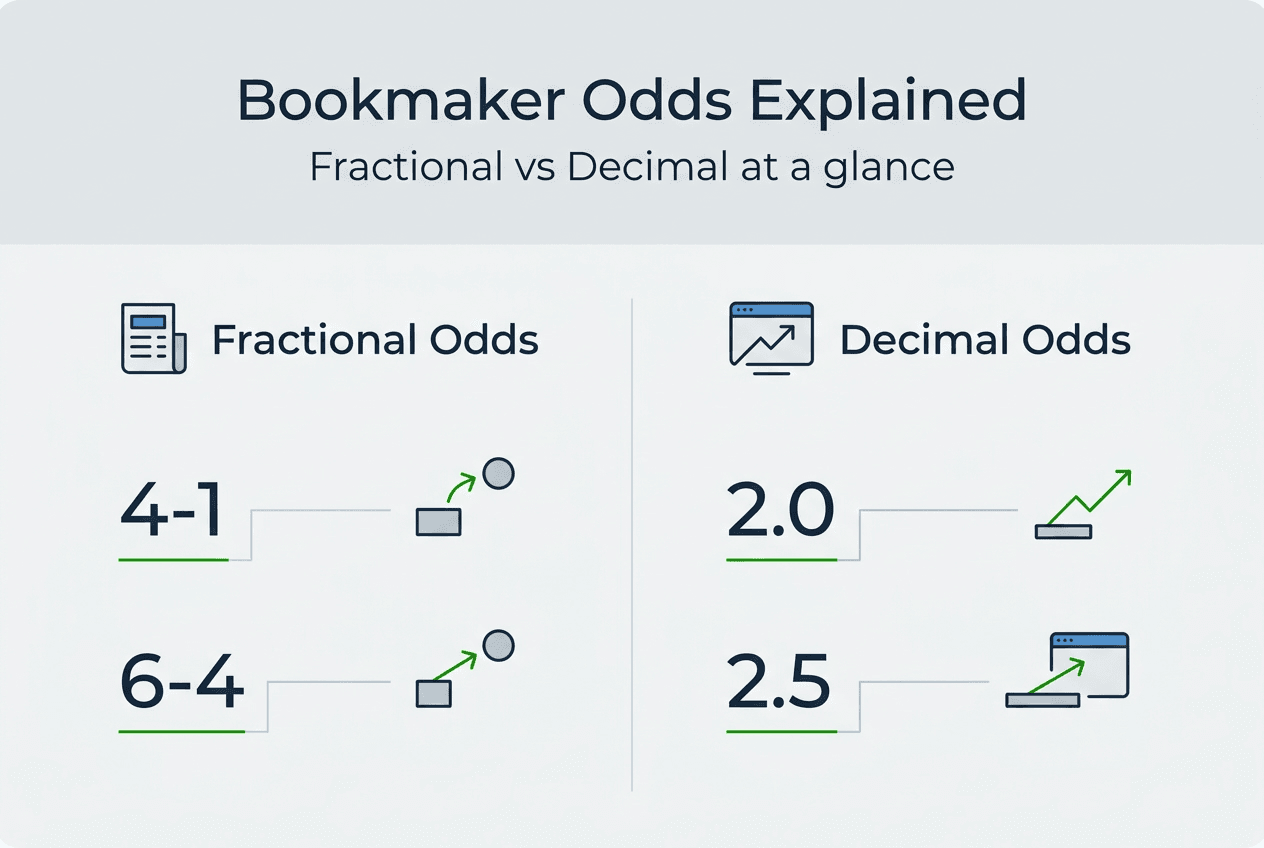
Fractional odds (a-b) show winnings per unit wagered, decimal odds (D) represent total payout per unit bet with conversion D=(a+b)/b. Fractional odds like 6-4 mean you win 6 units for every 4 units staked, plus your original stake returned. So a £10 bet at 6-4 returns £15 profit plus your £10 stake for a total of £25. The format is intuitive for calculating profit but requires an extra step to determine total return.

Decimal odds simplify the mathematics by expressing the total payout multiplier directly. Odds of 2.5 mean every £1 wagered returns £2.50 total, including your original stake. A £10 bet at 2.5 returns exactly £25. The profit is simply (2.5 × £10) minus £10 equals £15. This format dominates European markets and most online platforms because it streamlines calculations and reduces errors.
Converting between formats requires precision:
- Take the fractional odds numerator and add the denominator (for 6-4, that's 6 + 4 = 10)
- Divide this sum by the denominator (10 ÷ 4 = 2.5)
- The result is your decimal odds equivalent
- To reverse the process, subtract 1 from decimal odds, then express as a fraction in lowest terms
Here's a reference table for common conversions you'll encounter:
| Fractional odds | Decimal odds | Implied probability |
|---|---|---|
| 1-1 (Evens) | 2.0 | 50.0% |
| 6-4 | 2.5 | 40.0% |
| 2-1 | 3.0 | 33.3% |
| 5-2 | 3.5 | 28.6% |
| 3-1 | 4.0 | 25.0% |
| 9-2 | 5.5 | 18.2% |
Understanding these conversions matters because different bookmakers may display the same probability in different formats, and recognising equivalent odds instantly helps you compare markets efficiently. When you're evaluating multiple betting strategies guide recommendations or scanning odds feeds, format fluency eliminates calculation delays that can cost you value in fast-moving markets.
Pro Tip: Always verify which odds format your platform uses before placing bets, especially when switching between bookmakers or using automated tools, because a misread format can turn a value bet into a terrible wager instantly.
The challenges and realities of profiting from bookmaker odds
Despite the mathematical precision available through statistical models and data analysis, consistently extracting profit from bookmakers remains extraordinarily difficult for the vast majority of bettors. The sports betting market operates with remarkable efficiency, meaning that exploitable edges are rare, fleeting, and often smaller than the transaction costs required to capitalise on them.
Research demonstrates that combining probabilistic prediction models with betting strategies may yield profit but market efficiency limits exploitability. Advanced statistical approaches in football betting, for example, can generate predictions with measurable accuracy improvements over baseline models. However, translating predictive accuracy into actual profit requires your model to be more accurate than the collective wisdom embedded in bookmaker odds, which already incorporate information from thousands of bettors, professional analysts, and algorithmic pricing systems.
The relationship between prediction quality and profitability is nonlinear and unforgiving. A model that correctly predicts 55% of outcomes might seem impressive until you factor in the 9-10% bookmaker margin and the reality that you need to consistently identify odds that are mispriced by more than this margin to break even after accounting for losing bets. Even sophisticated bettors using sports betting statistical models face several persistent challenges:
- Bookmaker limits on winning accounts restrict bet sizes and eliminate profit potential
- Odds move rapidly as information spreads, closing value windows within minutes
- Transaction costs including commissions and currency conversions erode thin margins
- Variance creates extended losing streaks even with positive expected value strategies
- Market liquidity constraints prevent large stake placement without moving odds
The efficient market hypothesis applies powerfully to sports betting. When odds are set, they already reflect an enormous amount of information processing. Your edge must come from either superior information that hasn't yet been priced in, or from identifying systematic biases in how bookmakers or other bettors price specific situations. Both sources of edge are difficult to maintain because bookmakers actively work to eliminate them through odds adjustments and account restrictions.
Market efficiency in sports betting means that by the time you've identified what appears to be value, thousands of other bettors and algorithmic systems have likely already spotted and bet on the same opportunity, moving the odds towards fair value and eliminating the edge you hoped to exploit.
This reality doesn't mean profitable betting is impossible, but it does mean that casual approaches relying on intuition or basic statistics will almost certainly lose money over time. Success requires combining rigorous analytical methods with disciplined bankroll management and realistic expectations about achievable returns relative to the effort invested.
Leveraging bookmaker knowledge for strategic betting decisions
Understanding how bookmakers operate and price markets transforms from theoretical knowledge into practical advantage when you systematically apply these insights to your betting approach. The key is recognising that bookmaker mathematics creates specific opportunities that disciplined bettors can exploit through careful market analysis and strategic tool usage.
Value betting starts with comparing your calculated probability of an outcome against the implied probability from bookmaker odds. When odds of 3.0 are offered on an outcome you assess at 40% probability, the bookmaker's implied probability is 33.3%, creating a 6.7% edge. Consistently identifying these discrepancies requires both accurate probability assessment and rapid odds comparison across multiple bookmakers. The margin awareness you've developed helps you distinguish genuine value from bookmaker traps where inflated odds compensate for reduced probability.
Automated tools become essential rather than optional when you're serious about exploiting bookmaker inefficiencies. Manually monitoring odds across 150+ bookmakers for multiple markets is impossible, but platforms that aggregate this data and flag opportunities in real time make systematic value hunting viable. The quickstart betting tools approach eliminates the multi-tab chaos that causes missed opportunities and calculation errors.
Practical strategies that leverage bookmaker understanding include:
- Comparing closing line value to assess whether your bets consistently beat the market's final assessment
- Focusing on niche markets where bookmaker pricing models are less sophisticated and inefficiencies persist longer
- Using arbitrage opportunities created by pricing discrepancies between bookmakers to guarantee risk-free returns
- Tracking bookmaker-specific patterns in how they adjust odds to identify systematic biases you can exploit
- Implementing strict staking plans based on Kelly Criterion or similar mathematical frameworks that account for edge size and bankroll
The mathematics of bookmaking also reveals why betting exchanges sometimes offer better value than traditional bookmakers. Exchanges match bettors against each other and charge a commission on winnings rather than building margin into odds, often resulting in prices closer to true probabilities. Understanding this structural difference helps you route bets to the most advantageous platforms for specific situations.
Pro Tip: Combine manual analysis for identifying value opportunities with automated software for monitoring odds movements and executing bets quickly, because the best edges often exist for only minutes before the market corrects the pricing inefficiency.
How Proppr can improve your bookmaker betting experience
Now that you understand bookmaker mechanics, odds mathematics, and the challenges of profitable betting, the logical next step is implementing tools that automate the complex calculations and market monitoring required to compete effectively. Proppr consolidates the multi-platform workflow into a streamlined Telegram interface that delivers the precise, mathematically verified insights serious bettors need.

The quickstart betting tools eliminate the traditional chaos of managing dozens of browser tabs by aggregating odds from over 150 bookmakers into single-command queries. Instead of manually comparing fractional and decimal odds across platforms, you receive instant analysis showing where genuine value exists based on the Cebro statistical model's probability assessments. The arb bot specifically targets arbitrage opportunities where bookmaker pricing discrepancies create guaranteed profit scenarios, automatically flagging situations where you can bet both sides of a market for risk-free returns.
For bettors focused on specific teams or leagues, the team bot provides comprehensive analysis incorporating player statistics, team form, and historical performance data that bookmakers use in their pricing models. This gives you the same informational foundation professional odds compilers use, levelling the playing field.
Key benefits of using Proppr for bookmaker-based betting:
- Automated odds monitoring across 150+ bookmakers saves hours of manual comparison
- Mathematical precision from the Cebro model eliminates guesswork and emotional betting decisions
- Real-time alerts for value bets and arbitrage opportunities ensure you never miss exploitable edges
- Customisable filters let you focus on specific markets, leagues, or bet types matching your expertise
Pro Tip: Advanced betting tools don't replace your analytical skills but multiply their effectiveness by handling the repetitive calculations and monitoring tasks, freeing you to focus on strategic decisions where human judgment adds the most value.
Frequently asked questions
What are bookmakers?
Bookmakers are commercial entities that accept wagers on sporting events and other outcomes, setting odds that incorporate a profit margin to guarantee returns regardless of results. They function as intermediaries between bettors, providing liquidity and market access whilst managing risk through mathematical pricing structures. Bookmakers differ from betting exchanges, which simply match bettors against each other and charge commission rather than building margin into odds.
How do bookmakers set odds?
Bookmakers use statistical models, historical data, and expert analysis to estimate true probabilities for each outcome, then adjust these probabilities to include a profit margin typically ranging from 5-15% depending on the market. Odds are dynamically updated based on betting patterns, with bookmakers moving lines to balance their exposure and protect against concentrated risk on specific outcomes. This continuous adjustment process means odds reflect both objective probability assessments and the collective sentiment of the betting market.
Can bettors consistently beat bookmakers?
Consistently beating bookmakers is extremely difficult due to efficient markets, built-in profit margins, and bookmaker countermeasures like account limits on winning bettors. Advanced statistical models and disciplined bankroll management can create small edges, but these require significant expertise, time investment, and acceptance of substantial variance. Most bettors lose money over time because they underestimate the mathematical disadvantage created by bookmaker margins and overestimate their ability to predict outcomes more accurately than market consensus.
What is the difference between fractional and decimal odds?
Fractional odds express profit relative to stake (6-4 means win 6 units per 4 units wagered), whilst decimal odds show total payout per unit bet including the original stake (2.5 means receive 2.5 units total per 1 unit wagered). Both formats represent identical probabilities and payouts, with conversion following the formula: decimal odds equal (numerator plus denominator) divided by denominator. The choice between formats is largely regional preference, with fractional odds traditional in the UK and decimal odds dominant across European and online betting platforms.
How does understanding bookmakers improve my betting?
Knowing how bookmakers price markets helps you identify genuine value by comparing bookmaker-implied probabilities against your own assessments, revealing situations where odds offer positive expected value. Understanding margin structures lets you evaluate whether a market is worth betting by calculating the bookmaker's edge and determining if sufficient value exists to overcome it. This knowledge also guides platform selection, stake sizing based on edge calculations, and recognition of when bookmakers have mispriced outcomes due to information gaps or systematic biases you can exploit through tools that automate complex odds analysis and market monitoring.